Pages

Sunday, December 4, 2011

A Spark of Insight

I felt slightly terrified when my supervising doctor told me that I’d have to speak with his patient and wife alone. The patient, a man in his early middle age, had come into the clinic the week before complaining of dark urine and fatigue. A CT scan confirmed that he had advanced pancreatic cancer. Whereas he had been planning a vacation with his family only a short time ago, he would now be contemplating his own death.

Knocking on the clinic room door, I felt my heart pounding out of my chest. What do I say to someone who’s just been diagnosed with a terminal illness? After greeting the patient and his wife, a woman with long brown hair and a gentle expression, I pulled out my pad of paper and plunged into a series of biomedical questions: What colour is the urine now? Do you have any nausea? When is it worst? Every time there was an awkward silence, I would quickly fill it with another question.

When the interview was nearly over, I looked up and saw the man looking despondent while his wife just stared at the floor. I had completely and utterly failed to make any connection at all. I realized that I had kept cutting him off when his answers began to veer into the emotional. Even out of the clinic, I sometimes feel guarded when talking with people I don't know well, and yet here I was expected to talk to a total stranger about his impending death.

My heart pounding, I put aside my pad, looked the man in the eye and asked, “How are you personally coping with this diagnosis?” The man started to speak but then lapsed into silence, a silence that seemed to stretch on and on as the clock ticked loudly onward. What do I do now? Did I say something wrong? I wondered. But I shoved these anxious questions aside while my stomach tied itself into knots. 

After what seemed like an endless interval, he resignedly said, “I just don’t know what to do.”

I had suddenly made a connection. The man opened up after that, explaining how frustrated he felt to be diagnosed with cancer at such a young age. He described how he envisioned the final chapters of his life; he didn't want extensive surgery or chemotherapy, but rather to just be at home with his family. Whenever he would struggle for words, his wife (now engaged with the conversation) would help him out. By the end of our interview, I felt like I had gained a much deeper understanding of his suffering. In turn, I think he appreciated that someone just listened to him. 

By putting aside my script and connecting with the patient on a personal level, I saw him as being much more than a series of symptoms. I better understood his illness in the broader context of his life, an understanding that can help shape the course of medical treatment and improve the quality of care.  As time goes on, I'm becoming better at ripping up my script in favour of the spontaneity of genuine conversation. Maybe this conversation is more awkward and uncomfortable, but it is undoubtedly a much deeper source of insight than scripted responses could ever be. 

Saturday, November 26, 2011

Sweet Escape

The short, stocky man wearing the blood-spattered apron approached me with a broad smile. In his hands he held the severed head of an elk
“Yer a med student, boy. Think you can stomach this?” he said with a chuckle, lifting the head to within a foot of my nose.

I exchanged a glance with my fellow medical students. None of us expected to be touring a Mennonite slaughterhouse today. We had come to Mount Forest, a small community two hours northwest of Hamilton, to spend the day learning about rural medicine and experiencing something of the old-order Mennonite culture in the area. The Mennonites are a fervently religious Christian sect that rejects the "corrupting" influences of modern technology. They live off the land as farmers, travelling from place to place via horse and buggy. 


Aside from trying to traumatize us with the head, our Mennonite host (whose name was Melvin) was gracious and informative. He was happy to field our questions about Mennonite life. Melvin works from 4 am to the late evening every day, tending to his farm and operating his butcher shop. He spoke passionately about the "brotherhood” amongst Mennonites, who are bound together by their shared sense of destiny. After escaping religious persecution in Europe, his community migrated to North America over two hundred years ago. They have sustained their culture by homeschooling their children, instilling in them a deep sense of religious obligation. For the Mennonites, life is about hard work, duty, family and service to God.

At the same time, their community is no paradise. Melvin explained that their youth are barred from attending “real” schools because it would tempt them to join modern society. Without education, a youth has little choice but to remain within the fold. That begs the question: Are the Mennonites bound together by the strength of their faith or by a social structure that makes it impossible to leave?

My brief encounter with the Mennonite culture was just the icing on the cake of a fascinating day of training. Arriving that morning in Mount Forest, I learned three ways of popping a dislocated shoulder back into its socket, sutured a pig’s foot and put an arm cast on an eight-year old boy. We were hosted by several of the town’s doctors, who were eager to tell us more about medical practice in rural Canada.

"High" actually refers to the town's elevation. 
Over a lunch of chili and peach cobbler, I thanked them for providing such wonderful training for free.
“Oh, there’s no such thing as a free lunch,” one of the doctors said with a slight smile. “We need you to settle here once you’ve graduated from medical school.”
“Are you facing a shortage of doctors?” I wondered.  
“A lot of the docs here are getting old. Frankly, we're one heart attack away from disaster,” he said grimly. 

Although I savoured my experience in Mount Forest, I'm still not sure whether I'd ever practice in such a remote setting. While I love the outdoors, community spirit and low housing prices, I find the social conservatism of rural Canada somewhat stifling. Meanwhile, I cherish the cultural diversity and liberal attitudes of big cities like Hamilton and Toronto. 

But wherever I end up practicing, I'll have no regrets about signing up for this training day. It felt so refreshing to break free from the monotony of tests and tutorials, a brief but sweet escape into rural Canada. 

Friday, November 11, 2011

First Jab

It’s been over two months since the rosy glow of orientation week, which seems like a distant memory. Winter has begun to settle on Westdale, and my morning walk to McMaster has become much brisker as the temperature has plummeted. But more than the weather has changed. I’ve moved from being absorbed in medical books and lectures to actually being at the bedside with patients. To put it more colloquially: “Shit's gotten real.”

I’ve been assigned to shadow a family doctor in another city for the next 6 weeks. He is an incredibly efficient and organized individual, with dozens of patients shuttling in and out of his office every day. 

He explained to me that he believes in throwing in students head first – letting them learn by struggling and making mistakes. In the first appointment, a large, amiable man bounded into the office, needing his blood checked.
“Is it OK if my student takes your blood today?” asked the doctor (he collects blood samples himself). This came as a surprise to me.
“Ummm, yeah. Yeah that would be fine,” said the patient hesitantly. I could tell that the man was enthusiastic about helping a student learn but wasn’t sure if he wanted to be at the other end of the needle when said learning actually took place. But he gave consent and seated himself on the examination table.

I uncapped a fat syringe, tied a band around his upper arm and watched as a vein emerged from his skin like a green submarine. I would have to go in at just the correct angle.

The doctor sensed my hesitation. “Jab it in,” he said sternly. The patient looked mildly terrified. I’m sure he was wondering: What if he misses? I was wondering the same. As I held the needle over his arm, I looked up and saw his big blue, puppy eyes looking back. You still want to help me learn, buddy?

I forced myself to stop over thinking. I slid the syringe easily through the first layer of fat and then felt it “pop” through the vein’s wall.
“Ow!” said the patient unhappily. Oops, I had gone too far.
“Draw back,” said the doctor. “Now… put in the first collection vial.” If the needle had gone in properly, blood would flow in. If not, we’d have to take it out and try again.

I gently picked up a vial and pressed it into the syringe. Thankfully, reddish-black blood gushed in, filling the vial in seconds. The patient sighed and relaxed as I filled another four vials. I went to the backroom and centrifuged the samples as the patient and doctor chatted about politics.

Practice. Whether you’re in professional school, a trade or at McDonald’s, you have to practice and practice a skill countless times to master it. Unfortunately, every medical student has his first injection, first lumbar puncture and first surgical incision, and a (possibly) terrified patient at the other end. Sure, we may have the chance to practice on rubber arms, but no synthetic device can ever fully mimic the human form. We must eventually try our skills on a live patient, and just hope that enough patients will be willing to risk extra pain from a student’s unsteady hand in order to advance the cause of medical learning.

We spent the rest of the day encountering a vast range of health problems, and getting to explore the human stories behind them. I took blood several more times, talked to an elderly man about his feelings of loneliness and comforted a girl with enlarged tonsils. It was refreshing to be immersed in the nitty gritties of clinical practice. While endless textbooks and lectures suck out your soul, seeing patients in real life leaves you feeling alive and connected. 

Sunday, October 30, 2011

Inner Beauty

I’ve never enjoyed going into the anatomy lab, and the times when I do, it's usually only out of necessity. The sight of shriveled, gray cadavers and prosected organs bathed in formaldehyde – a powerful, odorous preservative – makes my stomach uneasy. And so it was with a sense of resignation that I put on my lab coat on Wednesday and went to the lab for a dissection. I washed my hands, snapped on a pair of rubber gloves and waited with nervous apprehension for whatever specimen was about to be plunked down on our table.

The lab coordinator walked over to my group with a metal tray bearing a pair of pig’s lungs and heart, which closely resemble their human counterparts. Unlike the preserved specimens, these organs were fresh, plump with hydration and gleaming red. My instant reaction: Wow, these are beautiful!

Even though our objective was to dissect the heart, I was far more fascinated by the lungs. I detached them with a few well-aimed slices and moved them over to my side of the tray. They are so incredibly soft that they jiggle when you prod them with your finger. The trachea, our windpipe, plunges through the top and separates into two main "bronchi", which further split into countless "bronchioles" with hundreds of millions of alveoli at their tips - microscopic sacs of air that exchange gases with the blood. I tried tearing an opening in the pleura (the membrane that bounds the lungs) with my hands - but it was incredibly tough,  the product of millions of years of evolution.

Fortunately the pleura stood no chance against my medical scissors. I cut through the lower right lobe like a knife through butter, revealing tiny air passages. Squeezing on the lobe, I felt an infinite number of little “pops” under my finger pads, the sensation of the delicate alveoli collapsing.

Our lungs have their own little universe within them, an intricate mosaic of airways, nerves and air sacs that sustain our breathing for our entire lives.

Later that day, on my car's radio, I listened to Christina Aguilera sing passionately about how we are all beautiful inside.

I couldn't agree more.

Friday, October 21, 2011

The Pulse of Human Connection

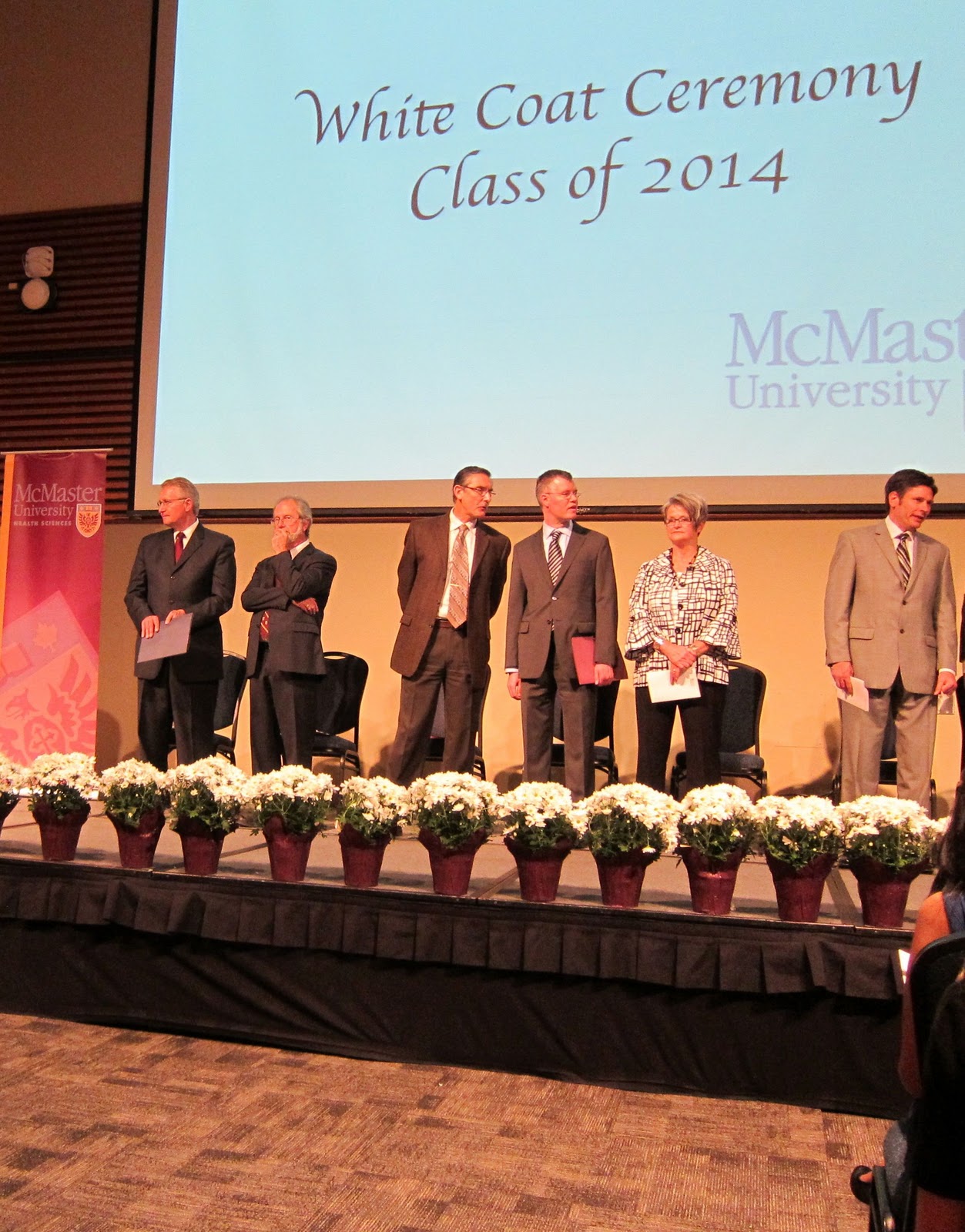
Two weeks ago, our medical school class received our white coats in a fancy ceremony at the Hamilton Convention Centre. It felt intimidating to walk up on stage in front of hundreds of people while one of the faculty members helped you put on your coat – I struggled to get mine on. Because McMaster has the second largest medical class in Ontario, we had to wait for over 200 students to walk across the stage. Afterwards we all headed into the main hall for refreshments and pictures.

To be honest, I feel a little pretentious wearing this white coat. I have never made a diagnosis, taken blood or even given a shot. And so it was a welcome relief a couple days later to shadow an internal medicine specialist in the Emergency Room of a local hospital. We stayed primarily in an area for patients (mostly very sick and elderly) being assessed for admission into long-term care. During my visit, the doctor focused mainly on an elderly man suffering from a severe infection and the beginnings of dementia. I, and a fellow classmate, performed basic cardiac and respiratory exams and helped hold the man as the doctor performed a rectal exam.

Here, the painful realities of medicine – of suffering and death – contrasted sharply with the glamor of the White Coat Ceremony. The old man we saw just wanted to be home with his wife, but he recognized that his body was failing and that he needed to be in hospital. I was surprised at how cheerfully he behaved, even though he was in a lot of pain and trapped in his hospital bed 24/7. He even told us a few snippets about his time fighting in World War II.

It was chilling to think about how this man was once strong enough to fight in a war, but was now extremely vulnerable and weak. When we asked him if we could perform certain exams, he always said, “Do whatever you want to do.” Clearly, he completely trusted his healthcare providers to protect and care for him in his final lap of life. I felt a need to do every thing that I could do (which is not much as a student) to make him feel comfortable. This was not just out a sense of caring, but also because I could imagine myself lying in that hospital bed one day, aged and sick.

The next day (Friday), hundreds of medical students from across Ontario descended on the Radisson Hotel in Sudbury for the annual Ontario Medical Students Weekend. I was expecting it to be an intense two days of skills training, but it turned out to be mostly a giant frat party. By 11 pm, the hotel was full of drunk med students being intermittently yelled at by the security guards for bringing alcohol into the hallways. At 2 am, a student pulled the fire alarm as a prank, and everyone in the hotel had to evacuate. Then the alarm was pulled again.

All of us exhausted, we began skills workshops the next morning. I learned how to suture using artificial, rubberized skin followed by a session on IV injection. The conference organizers provided us with these incredible rubber arms that had their own veins and a working system of blood supply. We learned how to find a “juicy” vein and inject the needle at the proper angle.


Since returning from the thrill and exhaustion of that weekend, I’ve buried myself in studying the heart’s conduction system, the current focus of our curriculum. I even went into the lab a couple days ago and held a few prosected hearts in my hand. Not to mention spending hours learning obscure cardiac medical terminology.

But I’ve realized that all this terminology, the white coat, the ceremonies – all pale in comparison to the value of connecting with the patient. While shadowing the internist, I had checked the heart rate of the elderly man. Placing my fingers over the bottom of his wrist, I felt his warm skin and a gentle pulse. I could sense the patient looking at me, and I felt a sense of deep appreciation from him. That sense of appreciation was more real than any ceremony could ever be. 

Sunday, October 9, 2011

The Drumbeat of Marriage


The day before yesterday, my aunt and uncle flew back to India. They had visited Canada for a month, staying in our guest bedroom and sharing in our daily lives. I felt uncomfortable at the prospect of this level of closeness after I found out that they had gotten their Visa to visit in early September. In the past it was always I who dropped in on their lives in Northeastern India, and when I did, it was just for brief spells of time.

Although they are nice people, I have always felt a sense of disconnection from them. We have vastly different beliefs on every facet of life imaginable – caste, marriage, religion, racial minorities, the role of women in society, gay people… I could go on. Their world view was developed in a traditional, middle-class Hindu household. Mine was forged in a liberal, interracial family living in Canada.

My father, the rebel, left that traditional Hindu lifestyle and married a Canadian woman. Although both sides of the family came to embrace the new couple, I often wondered how I would be viewed in my Indian family as a half white, Westernized young man. Would I be considered Indian? Would my grandmother still insist on arranging my marriage?

The answers to these questions have become much more clear over the past month. Little did I know, I occupy an important position within my extended family hierarchy. I am the oldest son of the oldest son of the oldest son on my father’s side. Take of that what you will, but the Hindu tradition regards this as being spiritually significant.

Even better, I apparently haven’t even let my Indian family down, despite my Westernization. Going into university, studying medicine and generally being well behaved mean that I’m a good Indian boy. But of course I’m going to fail the next and perhaps most important step: marrying an Indian girl.  

The older generations of women in Indian families comprise a highly effective marriage machine. As soon as a young man has graduated from his studies, they begin to sweep through their vast networks of friends and track down girls to marry. Once they decide on a suitable prospect, they arrange a meeting between the woman and man. If they like each other, then they will get hitched in a massive ceremony several months later. They may not even see each other until the wedding. 

Oftentimes, as with my uncle, the man leaves the responsibility of selecting his wife entirely to his mother and grandmother. His objective is to find a beautiful and hopefully docile girl from within his caste. But in turn there are factors that affect his attractiveness as a potential suitor;  first his income and caste with his height and looks as distant, secondary factors. 

Not to boast, but since getting into medical school I’ve become an ideal Indian groom. A doctor’s salary in Canada is enormous when converted to rupees (the Indian currency). My father was also of a “decent” caste, I’m tall, fair-skinned (a plus) and can speak Hindi. My dad claims, quite seriously, that my grandmother could have a long line of gorgeous Indian girls waiting to marry me, ready to serve me hand and foot for the rest of my life and have my children – two is traditional.

Personally, that sounds like a nightmare. I don’t want someone to marry me based on economic convenience, and I don't want to marry purely on looks; what about factors like a sense of humour, kindness and personal interests? Sure, on paper it may sound like a good idea to marry a random, beautiful brown girl – but what happens when you find out that you don’t get along with said hottie? What if she has a terrible temper or hates puppies?

Sadly, in my experience, many arranged marriages end up cold and lifeless but stay bound together for life because of the deep taboo against divorce in India. Faced with this prospect, young Indians turn to Bollywood films to get their fix of love relationships. It’s also becoming trendy among middle class youth to have a wild love affair with whomever they like before settling down into an arranged marriage with their family’s chosen suitor.

While we were shopping last week, my aunt suddenly asked, “So... what nationality will you marry?”
I replied, “It could be Indian, or black, white, Chinese… whoever I fall in love with.”
She smiled. “So it will be a surprise?” For a second I imagined introducing my future spouse to my Indian family. 
All I could say was, "Yes auntie. It will probably be a very big surprise."

Monday, October 3, 2011

When Life Gives You Lemons...

Hanging out with friends as an eleven-year-old, I went into the kitchen and came back with a lemon and salt shaker. After slicing it neatly it half, I showered it with salt and devoured one of the halves in a couple minutes. This particular lemon was plump, sour and delicious. 

To my surprise, both my friends looked horrified.
"Why... why would you do that?" one of them stammered. The other gave me a look that said: You're weird.

I suddenly got the awful sensation of being "different". I had assumed that eating lemons as a snack was perfectly normal; after all, my sister did it too! 

After they left, I shoved the uneaten half into a bag and shoved it in the fridge. From time to time, I would jostle by it as I reached for milk or butter. I would stare at the lemon... and it would stare right back. I wanted to douse that sucker with salt and spices and devour it. But I resisted... I didn't want to be that weird guy who ate lemons. I didn't want to be different.

And so I let the lemon, once so vibrantly yellow and bursting with juice, shrivel and brown until my mom threw it away.

As the weeks, months and years passed, I stopped eating lemons altogether. Once in a while I would get a craving and cave in, bicycling to the grocery store and later guiltily eating a lemon alone in my bedroom. At restaurants, I would sometimes try to chew on the cut-up lime they give you along with your drink. But to be honest, a lime is too sharp and bitter to be eaten raw. It really is a sad excuse for a fruit.

But soon I had a surprising experience that changed my attitude toward lemons forever. After high school, I flew to India to volunteer for a few months. Sitting in the living room of one of the locals, I was surrounded by a sea of brown faces eager to see the videshi or "foreigner". Then, to my great surprise, a young boy walked in bearing two gigantic, juicy lemons the size of soccer balls.

This picture would be perfect if it wasn't for the girl.
So this is what lemons are like in India, I thought. My host cut up one of those mammoth specimens and served me several lemon slices in a bowl, along with a packet of masala (Indian spice). I showered them with the spice and squeezed the salty-sour juice into my mouth; raw and delicious. It felt great to be alive.

Flying back to Canada, I couldn't help but ask myself: Why did I deprive myself of this pleasure for so many years? 

We change ourselves all too easily to fit in with the expectations of others, especially as kids. While it's natural to seek acceptance, sometimes those expectations don't make any sense and we end up losing a precious part of ourselves. Beyond citrus fruits, this could extend to major life decisions. It could be a boy who, despite his love and talent for painting, trades in his brushes for dumbbells because his father thinks that painting isn't manly. Or a woman who rejects friends from outside her ethnicity because of the closemindedness of her own cultural tradition. 

Fortunately, we have the ability as (young) adults to consciously be our genuine selves, but it may take a long time for us to recognize that. In my gap year, I would weightlift for at least an hour a day and down protein shakes like they were candy. Eventually I realized that I was subconsciously doing this to seek others' approval, as if there were a correlation between muscle mass and worthiness as a person.

Now I spend most of that time reading great books and writing (this blog included). Sure, I'll miss the bulging muscles (*ahem*) but living out my genuine interests has made life far more fulfilling. Whether it's choosing what you study, who you love or how you worship (or what citrus fruits you eat), basing your decisions on authentic passion rather than programmed fears opens up life in countless new ways.