Pages

Sunday, October 9, 2011

The Drumbeat of Marriage


The day before yesterday, my aunt and uncle flew back to India. They had visited Canada for a month, staying in our guest bedroom and sharing in our daily lives. I felt uncomfortable at the prospect of this level of closeness after I found out that they had gotten their Visa to visit in early September. In the past it was always I who dropped in on their lives in Northeastern India, and when I did, it was just for brief spells of time.

Although they are nice people, I have always felt a sense of disconnection from them. We have vastly different beliefs on every facet of life imaginable – caste, marriage, religion, racial minorities, the role of women in society, gay people… I could go on. Their world view was developed in a traditional, middle-class Hindu household. Mine was forged in a liberal, interracial family living in Canada.

My father, the rebel, left that traditional Hindu lifestyle and married a Canadian woman. Although both sides of the family came to embrace the new couple, I often wondered how I would be viewed in my Indian family as a half white, Westernized young man. Would I be considered Indian? Would my grandmother still insist on arranging my marriage?

The answers to these questions have become much more clear over the past month. Little did I know, I occupy an important position within my extended family hierarchy. I am the oldest son of the oldest son of the oldest son on my father’s side. Take of that what you will, but the Hindu tradition regards this as being spiritually significant.

Even better, I apparently haven’t even let my Indian family down, despite my Westernization. Going into university, studying medicine and generally being well behaved mean that I’m a good Indian boy. But of course I’m going to fail the next and perhaps most important step: marrying an Indian girl.  

The older generations of women in Indian families comprise a highly effective marriage machine. As soon as a young man has graduated from his studies, they begin to sweep through their vast networks of friends and track down girls to marry. Once they decide on a suitable prospect, they arrange a meeting between the woman and man. If they like each other, then they will get hitched in a massive ceremony several months later. They may not even see each other until the wedding. 

Oftentimes, as with my uncle, the man leaves the responsibility of selecting his wife entirely to his mother and grandmother. His objective is to find a beautiful and hopefully docile girl from within his caste. But in turn there are factors that affect his attractiveness as a potential suitor;  first his income and caste with his height and looks as distant, secondary factors. 

Not to boast, but since getting into medical school I’ve become an ideal Indian groom. A doctor’s salary in Canada is enormous when converted to rupees (the Indian currency). My father was also of a “decent” caste, I’m tall, fair-skinned (a plus) and can speak Hindi. My dad claims, quite seriously, that my grandmother could have a long line of gorgeous Indian girls waiting to marry me, ready to serve me hand and foot for the rest of my life and have my children – two is traditional.

Personally, that sounds like a nightmare. I don’t want someone to marry me based on economic convenience, and I don't want to marry purely on looks; what about factors like a sense of humour, kindness and personal interests? Sure, on paper it may sound like a good idea to marry a random, beautiful brown girl – but what happens when you find out that you don’t get along with said hottie? What if she has a terrible temper or hates puppies?

Sadly, in my experience, many arranged marriages end up cold and lifeless but stay bound together for life because of the deep taboo against divorce in India. Faced with this prospect, young Indians turn to Bollywood films to get their fix of love relationships. It’s also becoming trendy among middle class youth to have a wild love affair with whomever they like before settling down into an arranged marriage with their family’s chosen suitor.

While we were shopping last week, my aunt suddenly asked, “So... what nationality will you marry?”
I replied, “It could be Indian, or black, white, Chinese… whoever I fall in love with.”
She smiled. “So it will be a surprise?” For a second I imagined introducing my future spouse to my Indian family. 
All I could say was, "Yes auntie. It will probably be a very big surprise."

Monday, October 3, 2011

When Life Gives You Lemons...

Hanging out with friends as an eleven-year-old, I went into the kitchen and came back with a lemon and salt shaker. After slicing it neatly it half, I showered it with salt and devoured one of the halves in a couple minutes. This particular lemon was plump, sour and delicious. 

To my surprise, both my friends looked horrified.
"Why... why would you do that?" one of them stammered. The other gave me a look that said: You're weird.

I suddenly got the awful sensation of being "different". I had assumed that eating lemons as a snack was perfectly normal; after all, my sister did it too! 

After they left, I shoved the uneaten half into a bag and shoved it in the fridge. From time to time, I would jostle by it as I reached for milk or butter. I would stare at the lemon... and it would stare right back. I wanted to douse that sucker with salt and spices and devour it. But I resisted... I didn't want to be that weird guy who ate lemons. I didn't want to be different.

And so I let the lemon, once so vibrantly yellow and bursting with juice, shrivel and brown until my mom threw it away.

As the weeks, months and years passed, I stopped eating lemons altogether. Once in a while I would get a craving and cave in, bicycling to the grocery store and later guiltily eating a lemon alone in my bedroom. At restaurants, I would sometimes try to chew on the cut-up lime they give you along with your drink. But to be honest, a lime is too sharp and bitter to be eaten raw. It really is a sad excuse for a fruit.

But soon I had a surprising experience that changed my attitude toward lemons forever. After high school, I flew to India to volunteer for a few months. Sitting in the living room of one of the locals, I was surrounded by a sea of brown faces eager to see the videshi or "foreigner". Then, to my great surprise, a young boy walked in bearing two gigantic, juicy lemons the size of soccer balls.

This picture would be perfect if it wasn't for the girl.
So this is what lemons are like in India, I thought. My host cut up one of those mammoth specimens and served me several lemon slices in a bowl, along with a packet of masala (Indian spice). I showered them with the spice and squeezed the salty-sour juice into my mouth; raw and delicious. It felt great to be alive.

Flying back to Canada, I couldn't help but ask myself: Why did I deprive myself of this pleasure for so many years? 

We change ourselves all too easily to fit in with the expectations of others, especially as kids. While it's natural to seek acceptance, sometimes those expectations don't make any sense and we end up losing a precious part of ourselves. Beyond citrus fruits, this could extend to major life decisions. It could be a boy who, despite his love and talent for painting, trades in his brushes for dumbbells because his father thinks that painting isn't manly. Or a woman who rejects friends from outside her ethnicity because of the closemindedness of her own cultural tradition. 

Fortunately, we have the ability as (young) adults to consciously be our genuine selves, but it may take a long time for us to recognize that. In my gap year, I would weightlift for at least an hour a day and down protein shakes like they were candy. Eventually I realized that I was subconsciously doing this to seek others' approval, as if there were a correlation between muscle mass and worthiness as a person.

Now I spend most of that time reading great books and writing (this blog included). Sure, I'll miss the bulging muscles (*ahem*) but living out my genuine interests has made life far more fulfilling. Whether it's choosing what you study, who you love or how you worship (or what citrus fruits you eat), basing your decisions on authentic passion rather than programmed fears opens up life in countless new ways.

Tuesday, September 27, 2011

Dancing on the Edges of Burnout

Note: any identifying patient details have been removed to preserve confidentiality. 

Last week I met my first patient ever. She was an elderly woman with shortness of breath and swollen legs. McMaster's medical school is famous for getting their students to see patients within the first month of classes. But in reality, at this point we know next to nothing about medicine. So I and a classmate were assigned the fairly straightforward task of taking a medical history.

The patient was sitting upright in her hospital bed being pumped with oxygen and an IV drip. We proceeded to ask questions over the next half hour, trying to build up a complete picture of the patient's medical history. I felt very out of place, shuffling through my notes while trying to figure out what to ask next. But the woman was patient and understanding. She also had a very dry sense of humour that made us laugh several times. 

It was likely her heart had become too weak to keep pumping enough blood to sustain her body. The clinical term is “congestive heart failure”. I felt sad, but the woman’s cheery mood and humour lifted my spirits. At the end, my supervisor thanked her for taking the time to speak with us.
“Oh yes, because I have a very busy schedule,” she deadpanned, alluding to the fact that she was in her hospital bed almost 24 hours a day. 

The only complication came early in the interview when the nurse changed the soiled diapers of a patient nearby. I have an extraordinarily sensitive nose and the smell hit me like a truck. Even if I was blindfolded in the morning, I could probably still sniff my way from class to class. This supersonic sense of smell can be a problem, since medicine is usually a smelly profession. But fortunately I got used to it quickly and it stopped bothering me. First test passed.

Although the clinical encounter was a high point, I feel like I've been rapidly burning out over the last two weeks. I’ve become overwhelmed with classes, extra-curricular commitments and studying. 12 hour days are becoming common place, and even once I get home there are countless more readings to do. 

Unfortunately this is very much self inflicted. I seem to have signed up for every extracurricular opportunity available - last week I registered myself for two medical conferences and a semester of hip hop classes. Facing a deluge of opportunities, it's too easy to say "Yes" to all of them.

Best show ever
When the second season of "Battlestar Galactica" arrived at the library, I knew I was doomed. Watching the riveting story of the power struggle between the Cylons and the remnants of humanity has eaten up the last bits of sleep that I enjoyed.

Fortunately the turning point came a couple nights ago, when I was watching a National Geographic documentary on the human life cycle. The narrator was talking about menopause when my eyes suddenly welled up with tears. This came out of nowhere; I was actually in a good mood. I guess our bodies start to do unpredictable things when we push them too hard. 

I dried my cheeks and reached for my sister's bottle of skin cream sitting on the desk. Smearing the cream over my face, I immediately grimaced - it was full of tiny, sharp particles. Exfoliator.

So here I was, exhausted and crying over a documentary about menopause while inadvertently exfoliating my face. I shut off the TV and went to bed.

Waking the next morning after a long rest, I felt determined to restore my sleep cycle and take better care of myself. Armed with this new determination, and with skin as smooth as a baby's bottom, I'll soon be ready to take on the world again. 

Tuesday, September 20, 2011

From Africa to Ancaster: A Fascinating Life

Nine candles sit on the enormous white cake at the front of the hall, their flames flickering as the chattering in the room quiets. Almost all at once, sixty voices begin to sing “Happy birthday” together. All eyes are focused on a dignified, elderly woman at one of the tables near the front; Bernice Trollope, my grandmother, or as I affectionately know her, “Nana”. They are celebrating 90 years of a remarkable life.

In 1921, Bernice was born in a tiny Norwegian settlement in South Africa. Her father, a Christian missionary, was often away on missions in Madagascar, leaving her mother to raise four children. There was no running water or electricity, and her family was so poor that they couldn’t afford shoes for her until she was five years old. But education promised a way out of these dire circumstances. Bernice hitched a ride with several other kids from her settlement on a horse-and-buggy that drove them to school every day.

Classically Norwegian, Bernice was a plump-cheeked, big-boned girl with auburn hair, ivory-skin and green eyes. She was very gentle and obedient, and her Grade 1 teacher remarked in her report card that she was “An excellent and disciplined pupil who takes herself too seriously.” Bernice fell in love with languages, becoming fluent in Norwegian, English and Afrikaans. She chose to become an English teacher.

Then, on September 4th, 1939, the Union of South Africa declared war on Germany following Hitler’s surprise attack on Poland. The declaration of war changed the life of every South African, and my grandmother voluntarily joined the army. She was trained to operate supply vehicles and monitor radar, and was promoted to Sargeant. 

During the war, she met a young engineer named William Trollope. He was skinny and rather awkward-looking but was charming, brilliant and had a fantastic sense of humor. He courted Bernice, but on a trip to Norway after the war ended, she became engaged to a Norwegian man. For some reason, the engagement fell through and Bernice returned to South Africa. A gregarious and successful man that she had known since childhood began to court her, but she reconnected with William and accepted his marriage proposal instead. 


Bernice envisioned a life in South Africa surrounded by her vast extended family. She despised Apartheid and opposed the nationalist government, but despite this, she loved the country passionately; its lush, tropical countryside and vibrant way of life. She didn’t realize that William did not share the same attachments. Shortly after they were married, he secured a two-year position at an engineering firm in Quebec, Canada.

This came as a shock to Bernice. Quebec seemed very foreign; a French-speaking province in a distant country with a cold, snowy climate. Most important, she was deeply connected to her family, and this would mean leaving them behind. But since it was only for two years, Bernice accepted the plan.

By now she and William had two children, including my mother. The little family arrived in Sherbrooke, Quebec to a small apartment, in the dead of winter. Bernice struggled to adjust to their new life in Quebec. Her body, especially her sinuses, couldn't cope well with the extreme cold. But she didn't complain and instead adapted herself, starting a small English school for French children. 

Bernice missed her family terribly during those years, especially her mother. Their only connection was through letters. And so it came as a huge shock when my grandfather decided that they would settle in Canada permanently. He didn't see a positive future for South Africa. Bernice was devastated by the decision, but she came from a generation where the husband made the big decisions. Sadly, she couldn't even visit her family for many years because of her family responsibilities.

Meanwhile, William fell into severe clinical depression that would last for most of the next two decades. Unfortunately, this was before the time of effective treatments for major depressive disorder. When he returned from work, he would immediately go to bed and only come out his room for supper. Bernice took on the responsibility for making family decisions, caring for the children and caring for William himself.

The family moved to Ancaster, but over the next years my grandmother's workload would only increase. William suffered through three different types of cancer brought on by a lifetime of smoking. When she was not taking care of him, she was volunteering at church. Her idea of Christianity is one of a loving, encompassing faith; last year, she voted in favour of allowing gay men and women to serve as priests within the Anglican church.

My grandfather died of leukemia in 2000. His depression had finally lifted in the last years of his life, and he enjoyed a relaxed retirement in his Ancaster home. Although it was heartbreaking for my grandmother, it also marked the start of a wonderful new phase in her life. She loved to travel but had always stayed home to care for her husband. 

And so we took a family trip to South Africa, crisscrossing the country. We celebrated Nana’s 80th birthday in the city of Pretoria and over a hundred family members and friends attended. I met the other man who had courted my grandmother all those years ago. Once she married William, he went on to marry another woman, had several kids and led a happy life in South Africa. 

I can’t imagine how different her life would have been if she had accepted his proposal. She could have stayed with her family in South Africa and avoided the decades of hardship created by my grandfather’s depression. Now, in her old age, she continues to be a nurturing influence on our tiny Canadian family; making countless pots of jams and blueberry pies, hosting family dinners and lending out her car. As a boy I would sleep over at her house every Friday, playing ridiculous word games with her while eating delicious heart-shaped waffles. She has always been a rock of stability in my life and the lives of all those close to her.  

But now as I look at my grandmother in the church, I realize how heavily time weighs upon her. Where once she was tall and strong, she is now stooped over and fragile, as if even a gentle breeze would blow her over. Although I’m sure she’s in pain from her aching hip or from the severe arthritis that wraps around her spine, she doesn’t show any trace of complaint. She never does. Instead she smiles as she greets her guests.

For her, life has always been about grace, dignity and quiet resolve.

Tuesday, September 13, 2011

Love in the Time of Medical School

I’ve always been a romantic. In Grade 4, my friend had an enormous crush on a blonde girl in our class named Megan. He was desperate to think of a way to woo her, but too shy to approach her directly. When he asked me what he should do, I hatched a plan to write anonymous love letters on his behalf and deposit them in Megan’s locker. My friend agreed to the plan, and a couple times a week I dictated romantic messages as he scribbled them down on dollar store stationary.

As it turned out, the plan badly backfired. Megan’s friends, upon learning of the anonymous letters, teased her relentlessly and immediately suspected my friend. Megan implored him to stop writing the letters, killing off any potential for a steamy romance.

Despite this setback, romantic feelings simmered and bubbled under my surface as the years passed. I had my first dance in Grade 6 with a cute brunette and then my first date in high school. I planned our date to be dinner at a nice Indian restaurant. A couple hours before, I bought a long-stemmed rose from the local florist, washed my car and put on my nicest shirt and pants. Pulling in front of her house, I took a deep breath and knocked on the door.

Her father answered. Shocked, I hid the rose behind my back and proceeded to talk with him for 5 minutes. Please, please don’t ask me what I’m hiding behind my back. Then you’ll know how lame I am, I thought. Once the girl finally came out and her father disappeared, I gave her the rose and she took a good whiff… I think she liked it. It was a lovely evening.

Unfortunately, once I entered university and became hyper-focused on getting into med school, my romantic life quickly fell by the wayside. I think the most romantic thing I did in undergrad was watch a rerun of The Notebook with my mom. Sadly, this trend looks to continue in medical school, as I find most of my time consumed with respiratory structures, cadavers and freaky medical disorders.

And yet I feel a constant undercurrent of desire for romantic love. It’s probably one of the most basic, primal needs one could have. Intellectually I know that I’m headed towards a nice career, and I live in a nice house with a caring family and great supports. I have many varied interests that I enjoy, like badminton and writing. I don’t want for any material goods.

But there’s something missing: the feeling of intimacy and closeness on a level much deeper than friendship. So many of our interactions on a daily basis are superficial and meaningless; the average “Hi! How are you?”

Love pierces this layer of superficiality. Two people in love know one other better than anyone else in the world; each other’s secrets, dreams and all the emotions, neuroses and vulnerabilities usually kept well hidden from the world. I believe a couple crosses the threshold of simply loving each other to falling in love when they form a powerful bond that is nearly unshakeable by any external force.

A man truly in love is the man who marries his fiancée even after she has been horribly disfigured in an accident. Or a woman who stays faithful to her husband through years of war.

The idea of establishing this deep connection with someone else seems like an incredible dream to me. One day I hope it comes true.

Monday, September 5, 2011

O-Week: It Begins!

Sunday, August 28th, 2011

I return at 4 am from a night of clubbing at Sizzle & Koi, a popular dance club in Hamilton. It's probably a bad idea to pull an all-nighter only a couple of nights before med school starts, but it's my last chance to see a couple of good friends before they take off to various parts of the world.

After four hours of restless sleep, I wake up with no hearing in my left ear. I figure that the loud, pounding music has temporarily deafened me. It's the day before school starts and I feel uneasy. I don't like being the new kid, even though everyone else is new as well. It's hard being thrown into a new environment surrounded by hundreds of people you've never met and expected to make friends, establish a routine and generally succeed.

Monday, August 29th

I file into a huge lecture hall in the McMaster School of Medicine at 8 am. Each administration member impart a few "words of wisdom". We get fitted into our new white medical coats and scrubs, the clothes you wear in the operating room. I hope that I don't have to wear scrubs too often, since seeing surgical procedures up close makes me a little queasy. The administrator implores us not to wear our scrubs while at the gym or out shopping - apparently it's happened before!

Next, our class of 207 is divided into teams and set out on a scavenger hunt. Our mission is to locate a list of places (eg: the fake goldfish bowl in Mills Library) and take funny pictures beside them. Since I know Mac so well, it's fun giving my fellow team-mates a little tour.

In the late afternoon, I collapse into bed exhausted. I'm sapped of energy and my hearing is still gone. I really didn't feel like going to the evening barbeque for the med students in the Dundas Driving Park, but the promise of free food is too much to resist. I should really see someone about my health. If only I was a doctor.

Tuesday, August 30th

The day begins with safety training and a lecture on financial management. These activities are followed by - SURPRISE - a huge bouncy-castle obstacle course! Two med students compete at a time, climbing over walls, throwing themselves down slides, and shimmying through narrow tunnels to get to the finish line. Even though I feel half-dead with whatever strange ailment is afflicting me, my competitive side kicks in and I win my match.

Wednesday, August 31st

We start with a thorough lecture on infection control. The speaker passes around a UV light that lets you see all the germs on your hands. Ew. From now on, I think to myself, I may carry around a bottle of Purell at all times. In the evening, I go with my family to "Little India" in Toronto to celebrate my dad and sister's birthdays. They happened to have both been born on August 23rd. Unfortunately, I discover that my favourite Indian snack has been banned from Canada by the government. That seems to be the fate of many imported Indian foods, which tend to be manufactured in unhygienic conditions. 

Thursday, September 1st

Medical class formal at Liuna Station, a beautiful former train station near downtown Hamilton that has been converted into a place for formal functions. It's also where my high school prom was held. I spend a lovely evening joking and laughing with my med school colleagues. Starting to make some friends.

Friday, September 2nd

Crisis. My left ear, which I've been neglecting for days, suddenly bursts during the night.The pain is so bad that I can't sleep or do anything. It feels like someone is dragging a serrated blade through the left part of my head. I finally see the doctor and she diagnoses a severe infection, prescribing a course of antibiotics. She tells me that this is one of the worst pains that the human body is capable of feeling. I somehow make it to the Niagara Wine Tour, the last event on the O Week calendar.

Since then...

Despite my ear problems, O Week was a great experience. Just like in Artsci, I found the people really interesting and friendly. I don't think there's such a thing as being a "nerd" in medical school, since every one is a nerd in some or other way. It's OK to break out into a conversation about classic novels or the merits of different voting systems without receiving a hostile stare. 

Even better, the days of cut-throat competition in medical schools are gone. The School of Medicine doesn't assign marks or rank its students, and instead students work collaboratively in groups. This fosters a trusting and non-competitive atmosphere. I appreciate that on an academic and personal level. I also feel excited to meet my first patients and begin to delve into the world of medical knowledge. In a profession where one has so many encounters - with patients, other med students, doctors - there are bound to be challenges. I plan to continue to use this blog to reflect on and share my experiences while on this incredible journey. 

Tuesday, August 16, 2011

A Summer of Transformation


When I'm old, I'll probably remember the summer of 2011 as a major turning point in my life. I began the month of May exhausted after 4 years of university. I had spent an obscene number of my waking moments thinking about, studying for and applying to medical school. It's a grueling process, partly because of the uncertainty of being rejected; what do you do then? Should you spend one, two, or even three more years reapplying? There's immense pressure to compete. For last year's class at McMaster, 3785 students applied and roughly 250 were sent offers of admission, with a final class size of 207.

I never thought that I'd actually make it, and I had little faith in myself as a student. I took the MCAT last summer, but for the first few days only studied a couple of hours per day. My practice test results were terrible. My thought process was: What's the point of studying hard when I won't get in anyways? Then, in early June I had a chance encounter with an old friend from high school at the movie theater, who told me that she studied for the MCAT every day from 9 to 11.
“Yeah, I do about 2 hours too,” I replied.
“No. 9 am to 11 pm,” she laughed.

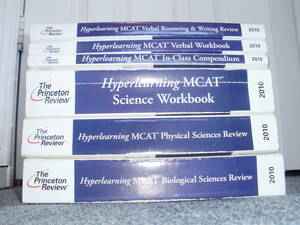
That was perhaps one of the most important conversations I've had in my academic career. I was frustrated with my poor study habits already, but the conversation made me question myself deeply: why was I pursuing this goal in the first place if I was unwilling to even put in the work necessary to achieve it? I felt a sense of urgency to study. The next day I  took my large stack of review books and studied from 9 am to 7 pm. I would take a break for an hour-long nap in the afternoon followed by lunch. This routine lasted consistently for the next 3 months, with just one day missed for an outing to Wonderland. 
My stack of MCAT books.
My new attitude was to do my best, even if I failed. In the month leading up to the exam, my practice tests were still below the cutoffs. But in the last two weeks I somehow managed to synthesize and absorb the material very efficiently, and I managed to do better on the MCAT than I had ever hoped.

My new attitude of "Try your best, even though you're not going to make it" carried me through a tough final year, long applications and several multiple mini interviews (which uses live actors to challenge applicants with realistic scenarios). In January, I was sitting in my Cell Bio class when a new message came in on my phone: a rejection from Queens for an interview. I felt shaken to my core and went back home. Lying on my bed a couple hours later, I checked my messages. Another email from Queens: Oops, sorry, we accidentally sent you a rejection. No, we'd actually like to invite you for an interview.

Phew! It turned out to be a technical glitch in Queens' computer system that affected hundreds of students and possibly caused a few heart attacks. Then came May 5th, the day when all the Ontario med schools inform applicants about whether they've been accepted or rejected. I woke up early, refreshed my Hotmail inbox and saw that I was accepted by Queens. Then Wendy Edge, admissions coordinator at McMaster, emailed me shortly thereafter with an offer of admission. I felt a deep sense of relief wash over me and a feeling that the last 4 years of work had been validated in an important way. 

I also felt like the medical profession had swept me up into its arms and planted me firmly on my life's path. I could suddenly envision the next 40 years of my life; not the details, but the general contours. I would study for three years, do my residency and then pick a specialty that suited my interests and skills. After becoming accustomed to uncertainty, this sense of clarity was a welcome change.

After giving my parents a hug, I called my Indian grandparents, who were perhaps more excited than anyone else. My grandmother had made several offerings at the Temple to her Hindu gods so that I would be admitted. Once she heard the news, she walked around her apartment complex an hour away from New Delhi and handed out sweets. I also talked with my "Dadadji" or grandfather on the phone for several minutes. He had grown up in dire poverty, and was naturally very happy.

After achieving this goal, I could finally concentrate on my personal growth more. At times I felt empty; when a certain goal occupies so much of your life, it tends to knock out everything else that is there. Now that the dream was fulfilled, it was replaced by many questions: OK, so I'm going to be a doctor. Who cares? What's the point of any of this? Is this all there is to life?

Those questions inspired me to read “Man's Search for Meaning” by Viktor Frankl, a holocaust survivor, and it's no doubt one of the most important books that I've read. It's about taking responsibility for your own happiness and actively creating meaning in life. I also planned out a summer with ample opportunity for new experiences, new friends, and plenty of self-reflection. A combination of working for the Census, traveling to Colorado and doing the Explore program in Quebec has given me a welcome chance to develop personally. I have a long, long way to go. But with med school less than two weeks away, I feel ready to tackle this new stage of my life.

New friends